

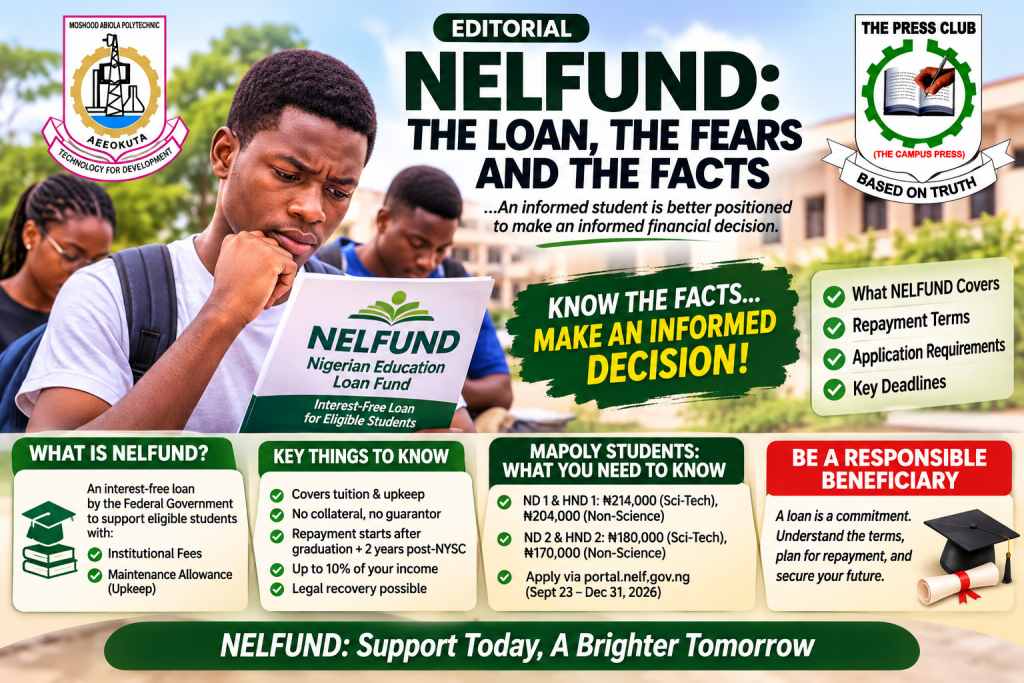
An informed student is better positioned to make an informed financial decision.
For many Nigerian students, financing higher education remains a major challenge. The cost of tuition, institutional charges and other academic expenses has placed considerable pressure on students and their families. In response, the Federal Government introduced the Nigerian Education Loan Fund (NELFUND) to provide financial assistance to eligible students.
However, the scheme has also generated concerns. While some students are uncertain about the application process, others are reluctant to apply because of fears surrounding repayment, possible legal action and the consequences of defaulting.
These concerns deserve attention. A loan, even when interest-free, is a financial obligation that should not be accepted without proper understanding.
To address these issues and clarify the application process, the Press Club, MAPOLY (PCM), met with the institution’s NELFUND Desk Officer on November 5, 2026. The meeting provided an opportunity to obtain information about the scheme and address questions affecting students.
During the engagement, the Desk Officer disclosed that over 900 students had applied for the 2026/2027 academic session, with their applications undergoing verification and processing.
The Press Club considers it important to present both the financial implications of the loan and the institutional requirements students need to understand.
WHAT DOES NELFUND ACTUALLY COVER?
Established under the Students Loans (Access to Higher Education) Act, 2024, NELFUND provides interest-free loans to eligible students in approved tertiary institutions.
The loan covers two major areas: institutional fees and maintenance allowance (upkeep).
Institutional payments cover tuition and other approved charges payable to the school, while upkeep provides financial support directly to eligible students during their studies.
The scheme does not require collateral or a guarantor, and the previous family income restriction was removed.
However, students must understand that interest-free does not mean free money. Whatever amount is approved and disbursed on their behalf remains a debt they are expected to repay under the applicable conditions.
WILL NELFUND SUE STUDENTS WHO FAIL TO REPAY?
This is one of the major concerns surrounding the scheme.
The answer requires understanding the provisions of the 2024 Act.
NELFUND is legally empowered to enter loan agreements and take appropriate recovery action against beneficiaries who fail to meet their repayment obligations. Therefore, it would be misleading to claim that the Fund has no legal means of recovering unpaid loans.
However, this does not mean students will automatically be taken to court immediately after graduation or simply because they cannot secure employment.
Under Section 28 of the Act, repayment begins when a beneficiary graduates and secures employment. The Fund cannot initiate enforcement action until two years after the completion of the National Youth Service Corps (NYSC) programme or exemption.
For beneficiaries in paid employment, repayment is made through monthly deductions not exceeding 10 per cent of their gross income.
For example, a graduate earning ₦200,000 monthly may have up to ₦20,000 deducted towards repayment.
What happens if a graduate remains unemployed?
The Act provides an option for beneficiaries who are unemployed and have no income to request an extension of enforcement action by submitting a sworn statement in the manner prescribed by the Fund.
This is not automatic loan forgiveness. Beneficiaries must follow the prescribed procedure and provide truthful information. Providing a false statement is a criminal offence.
Self-employed beneficiaries are also expected to update their business and income details with the Fund. NELFUND’s loan terms require such beneficiaries to provide the relevant business information within 60 days of becoming self-employed.
It is therefore important for students to understand that repayment is structured around their employment and income circumstances, rather than being an immediate demand for money upon graduation.
The loan terms also permit the Fund to use lawful recovery mechanisms, including the Global Standing Instruction (GSI), where a beneficiary fails to repay when the debt becomes due. Legal action is also possible. Students should therefore read and understand the loan agreement before accepting the facility.
What MAPOLY Students Needs To Know
Following the November 5 engagement, the Desk Officer provided clarifications on the application requirements for the 2026/2027 academic session.
1. ND 1 STUDENTS ARE ELIGIBLE
ND 1 students who are 18 years and above can apply, subject to other eligibility requirements. However, fresh students must first pay the compulsory tuition fee of ₦65,000 to activate their matriculation numbers. The matriculation number is required for institutional verification.
2. APPROVED SCHOOL FEES
According to the fee breakdown provided by the Desk Officer, ND 1 and HND 1 Science and Technology students, including Mass Communication, have an approved institutional loan amount of ₦214,000, while Non-Science students have ₦204,000.
For ND 2 and HND 2, Science and Technology students, including Mass Communication, have an approved amount of ₦180,000, while Non-Science students have ₦170,000.
These amounts cover tuition and approved service charges. Students should cross-check the figures on their NELFUND and MAPOLY portals.
3. REQUIREMENTS FOR FRESH STUDENTS
ND 1 and HND 1 applicants are expected to provide their matriculation number, JAMB registration number, programme of study, current academic level and admission letter. A school identity card is optional.
HND 1 students transferring from other institutions who have never applied should await the necessary institutional upload. Those who previously applied should complete the Change of Institution process where applicable.
Newly admitted HND 1 students for the 2026/2027 session are not required to register their JAMB details on the MAPOLY Centre for Entrepreneurship Development (MAPCED) portal, according to the Desk Officer.
4. REQUIREMENTS FOR RETURNING STUDENTS
ND 2 and HND 2 students who applied during the 2025/2026 session are required to reapply through the official NELFUND portal.
Those who did not apply during the previous session should submit their JAMB registration number, National Identification Number (NIN) and date of birth through the MAPCED portal, following the prescribed instructions.
UPKEEP ALLOWANCE
Students applying for the ₦20,000 monthly upkeep allowance are required to provide their Bank Verification Number (BVN) and NIN.
According to the Desk Officer, OPay, Moniepoint and PalmPay accounts are not accepted for the institution’s current payment process. Students are advised to use commercial bank accounts.
Names on the MAPOLY portal must also correspond with those on their JAMB, NIN and BVN records to avoid verification difficulties.
UNDERSTANDING APPLICATION STATUS
Another concern among students is the meaning of the different statuses displayed on the NELFUND portal.
A ‘Sent to Institution’ status does not automatically mean rejection. It indicates that the application has been forwarded to the institution for verification and processing.
Similarly, ‘Missing Information’ may indicate that some required institutional details are yet to be uploaded. Students should seek clarification rather than assume their applications have failed.
Students who have already paid their school fees should also understand that selecting the institutional payment option does not mean they automatically lose their money. NELFUND pays approved institutional charges directly to schools, while applicable refunds or reconciliation are handled by the institution.
The Desk Officer further clarified that part-time students are not eligible under the institution’s current application guidance.
APPLICATION DEADLINE
The application window for the 2026/2027 academic session opened on September 23, 2026, and is scheduled to close on December 31, 2026.
Students should take note of this deadline and ensure that their application details and supporting information are correctly submitted.
The official application portal is portal.nelf.gov.ng.
NELFUND is an important intervention, but students must understand that it comes with financial responsibilities. The decision to accept the loan should be informed by a proper understanding of its terms, coverage and repayment conditions.
At the same time, the Federal Government must ensure that the scheme remains transparent and sustainable while addressing the unemployment challenges that may affect graduates’ ability to repay.
MAPOLY management must also sustain its sensitisation efforts and provide students with accurate information on application requirements, verification and disbursement.
The Press Club, MAPOLY, believes that students deserve more than application instructions. They deserve clear information about the financial commitments they are undertaking and the rights and obligations attached to them.