

Tomi Da’Curious
Across student associations in Moshood Abiola Polytechnic, annual dinners and award ceremonies have become a familiar way of celebrating students who distinguish themselves in leadership, academics, entrepreneurship, media, service and other areas of campus life.
From departmental associations to the Students’ Union Government (SUG), students are nominated for categories designed to recognise their contributions to the institution and their fellow students.
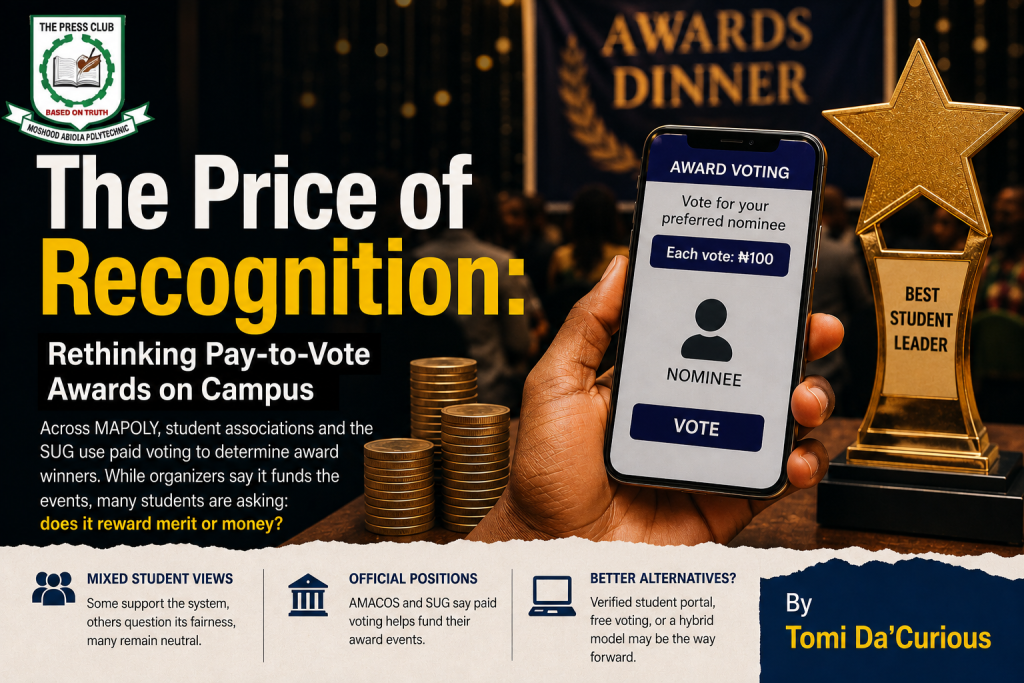
But behind the glamour of the dinners, plaques and certificates is a question that deserves closer attention: when students have to pay to vote for award nominees, does the system recognise merit, or does it reward the ability to mobilise financial support?
The question is not necessarily about whether the organisers are acting improperly. Rather, it concerns whether the method used to determine winners reflects what the awards claim to celebrate.
Where the Money Comes In
The AMACOS Dinner and Awards provides a useful example of how the system operates
According to the association’s Public Relations Officer, the awards are not funded from association dues or money in the association’s account. The Dinner and Awards is a long-standing tradition inherited from previous administrations, and the current executives have retained the existing structure.
The PRO explained that revenue generated through the official voting process is used to finance the event, including plaques, certificates, logistics and other event-related expenses.
The nomination process itself is open to students. Members nominate individuals they believe have distinguished themselves in particular areas. A student who believes a Head of Class has performed exceptionally, for instance, can nominate that person for Best Head of Class of the Year.
The process therefore begins with peer recognition.The concern arises at the voting stage. Under the AMACOS voting guidelines, each vote costs ₦100, while supporters can vote as many times as they wish. Each category requires a minimum of 500 valid votes, and where two or more nominees cross the threshold, the nominee with the highest number of valid votes emerges as the winner.
The association also states that only votes confirmed through its official voting platform are counted, while attempts to submit fraudulent payment evidence or manipulate the process can result in disqualification.
For the organisers, therefore, the system serves a practical purpose: it generates the money required to hold the awards without taking funds from students’ association dues.
However, does a funding mechanism necessarily make an effective award mechanism?
When Popularity Meets Purchasing Power, Student opinions gathered by the Press Club MAPOLY were mixed.
Some students did not consider the payment system problematic, particularly because they were not personally responsible for funding the votes. For them, the system is simply another way of supporting a candidate while helping organisers finance the event.
Others, however, questioned what exactly is being measured when votes are purchased. Their concern was that an award could begin to recognise the person who is most capable of raising money and convincing people to pay, rather than the person who most clearly demonstrates the qualities attached to the award category.
Some students also took a neutral position, recognising both sides of the argument: the financial realities of organising an award dinner and the concerns about whether paid voting can adequately measure merit.
This division is important because it shows that the issue is not simply one of students being against the payment system. The disagreement is fundamentally about what a campus award should represent.
If an award is titled “Best Student Leader,” for example, should the winner be determined entirely by the number of paid votes received? Or should leadership performance, service, impact and other measurable criteria also influence the outcome?
A Wider Campus Practice
The practice is not limited to AMACOS.
The SUG also organises awards using a similar paid-voting model, according to the union’s PRO, who was contacted by the Press Club for the union’s perspective. The similarity in the explanations offered by student association officials points to a broader issue: paid voting is not simply an isolated decision by one association but a model that has become part of how some student awards are financed and determined.
This makes the conversation bigger than any single Dinner and Awards. It becomes a question about how student communities define and measure recognition.
What Research Says About Popular Voting
Research into voting-based recognition systems also suggests that public voting does not necessarily produce a pure measurement of merit. A study published in the Creative Industries Journal examining a national music competition in Germany found that contestants’ pre-existing popularity positively influenced their voting outcomes.
The researchers concluded that media presence and previous popularity could affect the results of audience voting.Similarly, research published in Research Integrity and Peer Review examined the possibility of using democratic voting to determine research funding.
Although the study found that voting could be workable, participants raised concerns including lobbying, vote rigging and the possibility of the process becoming a popularity contest.
A candidate with a large network of supporters may be able to mobilise hundreds of people to vote. Another candidate may have equally strong achievements but fewer supporters who can afford to participate repeatedly.
Both candidates may be equally deserving. Yet the voting structure could produce different outcomes.
Can the System Be Improved?
The solution may not necessarily be to abolish student voting. Instead, associations may explore ways of retaining student participation while reducing the influence of financial capacity. One option already exists within the institution.
MAPOLY’s student portal is used for several important academic and administrative functions. Students use their matriculation numbers and passwords to access the platform, pay association dues, generate receipts, register courses and access uploaded results. The same system is also used for student executive elections.
Unlike the award voting system, students do not pay to vote for the President, PRO or other student executives. They log into the portal, select their preferred candidates and cast their votes. The model is not necessarily perfect, and no digital voting system can be assumed to be completely immune from manipulation. However, because the portal already has an authentication system tied to students’ identities, it could provide a foundation for a one-student, one-vote award system.
Another possibility is the use of free WhatsApp polls after nominations have been concluded. Such polls would remove the financial barrier and could encourage participation. However, they would be less secure because links can potentially be shared with people who are not students. WhatsApp polls could serve as a supplementary engagement tool, while the verified student portal could remain the primary voting platform.
A third option would be a hybrid system.Under such a model, students could vote freely through the verified portal, while an independent panel assesses nominees against clearly stated criteria. Public voting could contribute a percentage of the final score, with the remaining percentage determined by factors such as achievement, leadership, service, innovation or measurable impact, depending on the category.
Such a system would preserve the voice of the student body without making financial capacity the central determinant of recognition.
Recognition Should Mean Something
The annual dinner remains valuable, students deserve opportunities to celebrate one another, and associations need sustainable ways to finance programmes.
The question, therefore, is not whether student associations should organise award ceremonies or whether they should find ways to fund them.
The question is whether the method of funding an award should also determine who wins it. Paid voting may be an effective fundraising mechanism. It may encourage candidates to mobilise their supporters and generate resources for an elaborate ceremony.
However, if the purpose of an award is to identify the person who best represents excellence in a particular category, then the process should be designed to measure more than a candidate’s ability to mobilise money. A student who wins Best Entrepreneur should ideally be recognised for entrepreneurial achievement. A Best Head of Class should ideally be distinguished by effective service and leadership. A Best Student Editor should ideally have demonstrated excellence in editorial work.
Popularity can be relevant. Student participation can be valuable. Fundraising can be necessary. But none should automatically replace merit. As student associations continue to celebrate excellence across MAPOLY, perhaps the next evolution of campus awards should not be about adding more categories or making the dinner bigger.
It should be about strengthening the process that determines who receives the recognition because recognition is most meaningful when students trust not only the person holding the plaque, but also the process that placed it in their hands.